

🧪 API Plant – Production Department Interview Questions & Answers – Top 50 Questions Every Pharma Production Professional Should Know
- Explain the complete API manufacturing process.
Answer:
A typical API manufacturing process converts starting materials into the final API through a sequence of chemical reactions and physical operations.
The general flow is:
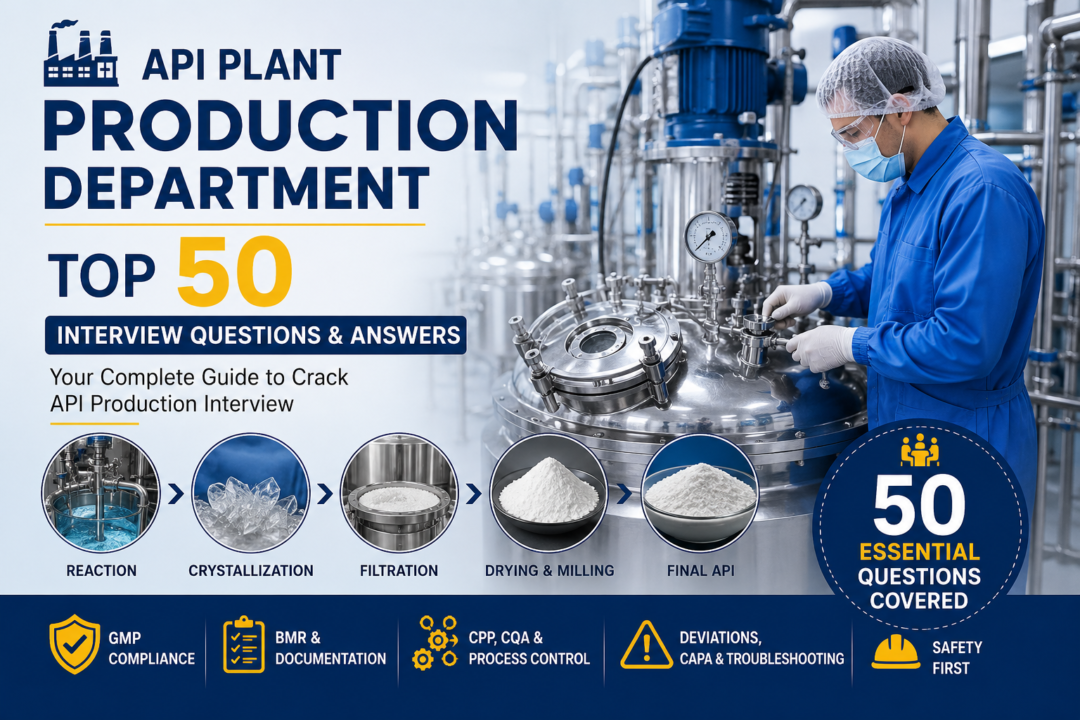
Raw Material Dispensing → Charging → Reaction → Quenching → Extraction/Phase Separation → Concentration → Crystallization → Filtration/Centrifugation → Washing → Drying → Milling/Sieving → Packing
The exact process varies according to the API.
During manufacturing, parameters such as temperature, pressure, pH, agitation, addition rate, reaction time, and drying conditions are controlled according to the approved manufacturing procedure. In-process controls and documentation are maintained throughout the process.
Interview point:
“Production is responsible for manufacturing the API according to the approved process while maintaining GMP, safety, process control, and complete documentation.”
- What is an API, and how is API manufacturing different from finished dosage-form manufacturing?
Answer:
API stands for Active Pharmaceutical Ingredient. It is the substance responsible for producing the intended pharmacological effect.
API manufacturing involves producing and purifying the active drug substance through chemical or biological processing.
Finished dosage-form manufacturing converts the API into a final pharmaceutical product such as:
- Tablets
- Capsules
- Injections
- Creams
- Suspensions
For example:
API → Paracetamol
Finished dosage form → Paracetamol tablet
API manufacturing generally involves operations such as chemical reactions, extraction, crystallization, filtration, drying and milling, whereas dosage-form manufacturing involves formulation and processes such as granulation, compression, coating, filling, or sterilization depending on the dosage form.
- What is GMP and why is it critical in API manufacturing?
Answer:
GMP means Good Manufacturing Practice. It is a system that ensures pharmaceutical materials and products are consistently manufactured and controlled according to established quality requirements.
In API manufacturing, GMP helps prevent:
- Contamination
- Cross-contamination
- Mix-ups
- Incorrect processing
- Documentation errors
- Use of unsuitable materials
- Unauthorized changes
GMP covers personnel, premises, equipment, materials, production, documentation, cleaning, quality control, validation, and quality systems.
Strong interview answer:
“GMP ensures that the API is manufactured consistently under controlled conditions, with proper documentation, traceability, quality oversight, and protection of product and patient safety.”
- What is a BMR? What information does it contain?
Answer:
BMR stands for Batch Manufacturing Record. It is an approved controlled document containing the manufacturing instructions and the actual recorded information for a specific batch.
It may contain:
- Product and batch details
- Batch size
- Raw material names and quantities
- Material batch numbers
- Equipment identification
- Charging instructions
- Process parameters
- Reaction times
- Temperature records
- In-process checks
- Yield calculations
- Manufacturing observations
- Operator/reviewer signatures
- Deviations or references where applicable
The BMR provides traceability of how the batch was manufactured.
- What is line clearance and why is it performed?
Answer:
Line clearance is a documented check performed before starting a manufacturing operation to confirm that the area and equipment are properly prepared and free from materials, labels, documents, residues, and products from previous operations.
It helps prevent:
- Product mix-ups
- Contamination
- Cross-contamination
- Incorrect labeling
- Documentation errors
For example, before starting a new API batch, Production verifies that material and labels belonging to the previous batch have been removed and the equipment has the required cleanliness/status.
- What checks should Production perform before starting a batch?
Answer:
Before starting, Production should verify the applicable requirements, including:
- Correct BMR/version
- Correct product and batch number
- Line clearance
- Equipment cleanliness/status
- Equipment identification
- Calibration status where applicable
- Availability and status of raw materials
- Correct material quantities
- Required utilities
- Required PPE
- Area readiness
- Availability of approved procedures
Any discrepancy should be addressed according to the applicable procedure before starting.
- What are Critical Process Parameters (CPPs)?
Answer:
CPPs are process parameters whose variability can affect a Critical Quality Attribute (CQA) and therefore require appropriate monitoring or control.
Examples in API manufacturing can include:
- Reaction temperature
- Reaction time
- pH
- Agitation speed
- Addition rate
- Pressure
- Vacuum
- Crystallization temperature
- Drying temperature
- Drying time
The actual CPPs depend on the specific API process.
Example:
If reaction temperature affects impurity formation, maintaining temperature within the established range becomes important for consistent product quality.
- What are Critical Quality Attributes (CQAs)?
Answer:
CQAs are physical, chemical, biological, or microbiological characteristics that should be within an appropriate limit, range, or distribution to ensure the required quality of the API.
Examples may include:
- Assay
- Related substances/impurities
- Residual solvents
- Water content
- Particle size
- Polymorphic form
- Microbial quality, where applicable
CQAs describe what quality characteristics the product must have, while CPPs are process parameters that can influence those characteristics.
- What is the difference between CPP and CQA?
Answer:
CPP = Critical Process Parameter
A process variable that can affect product quality and therefore requires control.
CQA = Critical Quality Attribute
A quality characteristic that must meet predetermined requirements.
Simple example:
Reaction temperature → CPP
Impurity level → CQA
If temperature is not properly controlled, it could result in increased impurities.
Easy way to remember:
CPP = Process
CQA = Product Quality
- What is the role of Production in an API plant?
Answer:
The Production Department is responsible for manufacturing the API according to the approved manufacturing process, GMP requirements, safety procedures, and quality requirements.
Major responsibilities include:
- Material handling
- Equipment operation
- Manufacturing operations
- Process parameter monitoring
- In-process activities
- Yield monitoring
- Documentation
- Cleaning coordination
- Safety compliance
- Reporting deviations
- Coordination with QA, QC, Engineering, Warehouse, and other departments
Production should achieve manufacturing targets without compromising quality, GMP, or safety.
- What checks should be performed before dispensing a raw material?
Answer:
Before dispensing, verify:
- Material name
- Material code
- Batch/lot number
- Approved/released status
- Expiry/retest information where applicable
- Required quantity
- Container integrity
- Label details
- Balance identification
- Balance calibration/status
- Dispensing area clearance
The material should be dispensed according to the approved instructions.
- What is dispensing and what precautions are required?
Answer:
Dispensing is the controlled weighing and issuing of raw materials required for manufacturing.
Important precautions include:
- Verify material identity and status.
- Confirm the correct quantity.
- Use a suitable calibrated/verified balance.
- Avoid material mix-ups.
- Maintain proper identification of dispensed material.
- Prevent contamination.
- Use appropriate PPE.
- Follow dust-control measures where required.
- Record the actual quantity accurately.
- What is material status: Quarantine, Released and Rejected?
Answer:
Quarantine:
Material is segregated and cannot be used until the required approval/release decision is made.
Released/Approved:
Material has passed the required assessment/testing and is authorized for use.
Rejected:
Material has been determined not to meet requirements and must not be used for manufacturing unless appropriately dispositioned according to the quality system.
Production should use only materials with the appropriate status.
- What is charging in API manufacturing?
Answer:
Charging means adding raw materials, solvents, reagents, catalysts, or other materials into a reactor or process vessel according to the approved manufacturing procedure.
Charging may be performed in a specific sequence and under specified conditions.
Important factors include:
- Material identity
- Quantity
- Charging sequence
- Addition rate
- Temperature
- Agitation
- Safety precautions
- What precautions should be taken while charging materials into a reactor?
Answer:
Before charging, verify:
- Correct material
- Correct quantity
- Correct reactor
- Equipment readiness
- Line clearance
- Required temperature
- Required agitation
- Correct charging sequence
- Appropriate PPE
- Required safety controls
For hazardous or reactive materials, controlled addition and appropriate engineering/safety controls are particularly important.
- Why is charging sequence important?
Answer:
Charging sequence can affect reaction rate, heat generation, mixing, impurity formation, safety, and product quality.
For example, adding a reactive reagent too quickly or at the wrong stage could cause an uncontrolled exothermic reaction.
Therefore, the approved charging sequence should be followed exactly unless a formally approved change is implemented.
- What would you do if the wrong raw material or incorrect quantity is identified?
Answer:
I would immediately stop or hold the activity as appropriate and inform the responsible supervisor.
I would not continue the process or attempt an unauthorized correction.
The event should be:
- Communicated immediately.
- Properly documented.
- Handled according to the deviation/nonconformance procedure.
- Investigated for potential product impact.
- Dispositioned through the appropriate quality system.
Never hide or alter the record.
- What is a reactor?
Answer:
A reactor is a process vessel used to carry out chemical reactions under controlled conditions.
Important reactor features may include:
- Agitator
- Temperature control system
- Heating/cooling arrangement
- Pressure/vacuum capability
- Addition ports
- Sampling arrangement
- Condenser/reflux system where applicable
The reactor allows the process to be performed under controlled and reproducible conditions.
- What parameters are commonly monitored during an API reaction?
Answer:
Depending on the process, common parameters include:
- Temperature
- Reaction time
- Agitation speed
- Pressure
- pH
- Addition rate
- Vacuum
- Solvent volume
- Reaction endpoint
Not every parameter is critical for every process. The approved manufacturing procedure defines what must be controlled and monitored.
- Why is reaction temperature critical?
Answer:
Temperature can significantly affect:
- Reaction rate
- Reaction completion
- Selectivity
- Impurity formation
- Yield
- Safety
If temperature becomes too high, unwanted reactions or increased impurities may occur. If it is too low, the reaction may become slow or incomplete.
Therefore, temperature should be controlled within the established process range.
- Why is agitation important?
Answer:
Agitation promotes proper mixing and heat/mass transfer.
It helps maintain uniform:
- Temperature
- Concentration
- Reaction conditions
Insufficient agitation may lead to poor mixing, localized temperature differences, incomplete reaction, or inconsistent processing.
- Why is controlled addition rate important?
Answer:
Controlled addition helps manage:
- Reaction rate
- Heat generation
- Temperature
- Local concentration
- Impurity formation
- Process safety
This is particularly important when adding highly reactive or potentially hazardous materials.
- What is an exothermic reaction?
Answer:
An exothermic reaction releases heat.
In API manufacturing, an uncontrolled exothermic reaction may cause:
Rapid heat generation → temperature increase → pressure increase → possible reaction instability or safety incident
Control measures may include:
- Controlled addition
- Cooling
- Temperature monitoring
- Appropriate agitation
- Process alarms/interlocks where applicable
- Defined operating limits
- What is reaction completion or endpoint?
Answer:
Reaction completion means the reaction has reached the required level of conversion according to predefined process criteria.
Depending on the process, reaction progress may be monitored using analytical techniques such as:
- HPLC
- GC
- TLC
- Other approved analytical methods
The process should not be extended, stopped, or modified arbitrarily. The approved procedure and applicable quality system should be followed.
- What is reaction hold time?
Answer:
Reaction hold time is the defined period during which the reaction mixture is maintained under specified conditions.
It is important because insufficient or excessive holding may affect:
- Conversion
- Impurity profile
- Yield
- Product quality
The established hold time and conditions should be followed.
- What is quenching?
Answer:
Quenching is a controlled operation used to stop or neutralize a reaction or deactivate a reactive component.
A quenching agent may be added under controlled conditions.
Important considerations include:
- Addition rate
- Temperature
- Agitation
- Gas generation
- Heat generation
- Final pH, where applicable
Quenching must be performed according to the approved process because it may itself be highly exothermic or hazardous.
- What is extraction?
Answer:
Extraction is a separation process in which a compound is transferred between phases based on its distribution or solubility characteristics.
In API manufacturing, extraction may be used to:
- Separate the desired compound
- Remove impurities
- Transfer material from one phase to another
The process may involve aqueous and organic phases.
- What is phase separation?
Answer:
Phase separation is the separation of two immiscible liquid phases, commonly:
Aqueous phase + Organic phase
The phases separate because they have different physical properties, particularly immiscibility and usually different densities.
Correct phase identification is important because removing the wrong phase can result in product loss or contamination.
- What is crystallization and why is it important?
Answer:
Crystallization is a controlled process in which a dissolved compound forms solid crystals.
In API manufacturing, it is commonly used for:
- API isolation
- Purification
- Recovery
- Control of crystal properties
The process can involve controlled cooling, concentration, solvent exchange, or anti-solvent addition.
The crystallization conditions can influence purity, yield, particle size, crystal form, and downstream filtration.
- What factors can affect crystallization?
Answer:
Important factors may include:
- Temperature
- Cooling rate
- Solvent system
- Concentration
- Anti-solvent addition
- Agitation
- Seeding
- Supersaturation
- Addition rate
- Holding time
Poor control can result in problems such as low yield, poor crystal formation, impurities, or difficult filtration.
- What is cooling crystallization and anti-solvent crystallization?
Answer:
Cooling crystallization:
The solution is cooled to reduce API solubility, causing the API to crystallize.
Anti-solvent crystallization:
A suitable anti-solvent is added to reduce the solubility of the API in the existing solvent system, promoting crystallization.
The appropriate technique depends on the specific API and established process.
- What is mother liquor?
Answer:
Mother liquor is the liquid remaining after API crystals have formed and been separated.
It may contain:
- Residual solvent
- Dissolved API
- Impurities
- Unreacted materials
Effective crystallization aims to recover the API while allowing appropriate impurities to remain in the mother liquor.
- What is filtration and what is filter cake?
Answer:
Filtration is a process used to separate solids from liquids using a suitable filter medium.
During API isolation:
API crystals + mother liquor → Filtration → Wet API cake + filtrate
The solid material retained on the filter is called the filter cake.
- What is centrifugation?
Answer:
Centrifugation separates solids and liquids using centrifugal force.
In API manufacturing, a centrifuge can be used to:
- Separate API crystals from mother liquor
- Wash the cake
- Remove liquid from the wet cake
Operating conditions must be controlled according to the equipment and approved process.
- What is the difference between filtration and centrifugation?
Answer:
Filtration:
Uses a filter medium to retain solid particles while liquid passes through.
Centrifugation:
Uses centrifugal force to accelerate separation of solids and liquids.
Both can be used to isolate API crystals, depending on the process and equipment.
- Why is API cake washing performed?
Answer:
Cake washing helps remove adhering:
- Mother liquor
- Soluble impurities
- Unreacted materials
- Residual process components
The approved washing solvent, quantity, temperature, and washing procedure must be followed because excessive washing can also cause product loss.
- What is drying and why is it critical for APIs?
Answer:
Drying removes unwanted moisture and/or residual solvents from the wet API cake.
It is important because excessive residual solvent or moisture can affect:
- API quality
- Stability
- Purity
- Physical properties
- Storage behavior
- Regulatory compliance
The drying endpoint should be established and verified according to the approved process and testing requirements.
- Why is vacuum used during API drying?
Answer:
Vacuum reduces the pressure inside the dryer and can lower the boiling point of solvents.
This allows solvent removal at a relatively lower temperature, which can be useful for temperature-sensitive APIs.
Vacuum drying can therefore improve solvent removal while helping minimize thermal stress, when appropriate for the process.
- What parameters are monitored during drying?
Answer:
Depending on the dryer and process, parameters may include:
- Temperature
- Vacuum/pressure
- Drying time
- Product load
- Agitation, where applicable
- Moisture content
- Residual solvent content
- Other established endpoint criteria
The exact requirements are process-specific.
- How do you determine whether an API is adequately dried?
Answer:
Adequate drying is determined using the approved drying endpoint criteria.
Depending on the API, this may involve checking:
- Water/moisture content
- Residual solvent
- Weight or loss on drying, where applicable
- Other approved tests
Simply drying for a fixed time does not necessarily prove that the required endpoint has been achieved.
- What problems can occur due to improper or excessive drying?
Answer:
Insufficient drying may result in:
- High residual solvent
- High moisture
- Stability concerns
- Failure to meet specifications
Excessive drying may potentially affect:
- Product physical properties
- Crystal form
- Stability
- Yield/recovery
- Other quality attributes
Therefore, drying should be performed within the established process conditions.
- What is milling and why is particle size important?
Answer:
Milling is a controlled size-reduction operation used to obtain the required particle-size characteristics.
Particle size can influence:
- Flow properties
- Surface area
- Dissolution
- Mixing
- Handling
- Downstream formulation performance
The required particle-size distribution depends on the specific API and its intended use.
- What precautions should be taken during milling and sieving?
Answer:
Important precautions include:
- Verify equipment cleanliness.
- Confirm correct equipment and screen.
- Perform required line clearance.
- Prevent contamination and mix-ups.
- Control dust generation.
- Follow grounding/bonding requirements where applicable.
- Use appropriate PPE.
- Maintain correct material identification.
- Record the operation properly.
For hazardous or combustible powders, additional engineering and safety controls may be required.
- What is the importance of API packing and storage?
Answer:
Proper packing protects the API from:
- Moisture
- Light
- Oxygen
- Contamination
- Physical damage
The approved container-closure system and storage conditions should be followed.
The package should also have the correct product identity, batch information, status, and required labeling.
- What would you do if a critical process parameter goes outside the specified limit?
Answer:
I would not make an unauthorized adjustment just to bring the parameter back into range.
My approach would be:
- Recognize and assess the immediate safety concern.
- Inform the responsible supervisor.
- Follow the applicable SOP/process instruction.
- Record the actual observation contemporaneously.
- Report/initiate the deviation as required.
- Support investigation and impact assessment.
- Follow the final approved disposition/instructions.
Strong interview statement:
“I would prioritize safety, immediately communicate the excursion, accurately document what actually happened, and follow the approved deviation and investigation process. I would never conceal or manipulate the record.”
- What is a deviation? Give an API Production example.
Answer:
A deviation is an unplanned departure from an approved procedure, specification, process parameter, instruction, or established requirement.
Example:
Suppose the approved process specifies a particular temperature operating range, but during the reaction the temperature exceeds the established limit.
That event may require deviation reporting and investigation according to the site’s quality system.
The investigation may evaluate:
- What happened?
- When did it happen?
- Why did it happen?
- Was the product affected?
- What corrective/preventive actions are required?
- What is CAPA?
Answer:
CAPA means Corrective Action and Preventive Action.
Corrective Action addresses the cause of an identified problem and helps prevent recurrence.
Preventive Action addresses potential causes or risks to prevent an undesirable event from occurring, as applicable to the quality system.
A typical approach is:
Problem → Investigation → Root Cause → CAPA → Implementation → Effectiveness Check
CAPA should address the underlying cause appropriately rather than simply treating the symptom.
- What would you do if you make a mistake while recording an entry in the BMR?
Answer:
I would follow the site’s approved Good Documentation Practice procedure.
Generally, the original entry should remain legible. The correction should be made appropriately, with the required identification/signature/date and reason where applicable.
I would never erase, overwrite, use correction fluid, or backdate an entry.
If the error is significant or requires additional assessment, I would inform the responsible person and follow the applicable procedure.
- What are ALCOA+ principles and why are they important?
Answer:
ALCOA+ represents principles used to support data integrity.
ALCOA:
A – Attributable
It should be clear who performed or recorded the activity.
L – Legible
The record should be readable.
C – Contemporaneous
Information should be recorded when the activity is performed.
O – Original
The original record or appropriately controlled source should be maintained.
A – Accurate
Information should be correct and truthful.
The “+” extends this with principles such as Complete, Consistent, Enduring, and Available.
Why important?
Production records are evidence of what actually happened during manufacturing.
Interview statement:
“Data integrity ensures that manufacturing records are reliable, traceable and trustworthy throughout the product lifecycle.”
- What are the major safety hazards in an API plant?
Answer:
API plants can involve several hazards, including:
🔥 Flammable solvents
May create fire or explosion risks.
🧪 Corrosive chemicals
Acids and alkalis can cause burns and equipment damage.
☠️ Toxic materials
Certain raw materials, intermediates, solvents, and APIs may be hazardous.
🌡️ Exothermic reactions
Can cause rapid heat generation and potentially pressure buildup.
💨 Pressure/vacuum
Improper operation can create equipment and personnel hazards.
⚙️ Mechanical hazards
Reactors, centrifuges, mills, pumps, and other equipment have moving components.
🌫️ Dust
Powder handling can create inhalation and, for certain materials, combustible-dust hazards.
⚡ Static electricity
Can be an ignition risk when handling flammable materials.