🎓 What Skills Do Pharmacy Students Need to Get a Job in the Pharma Industry?
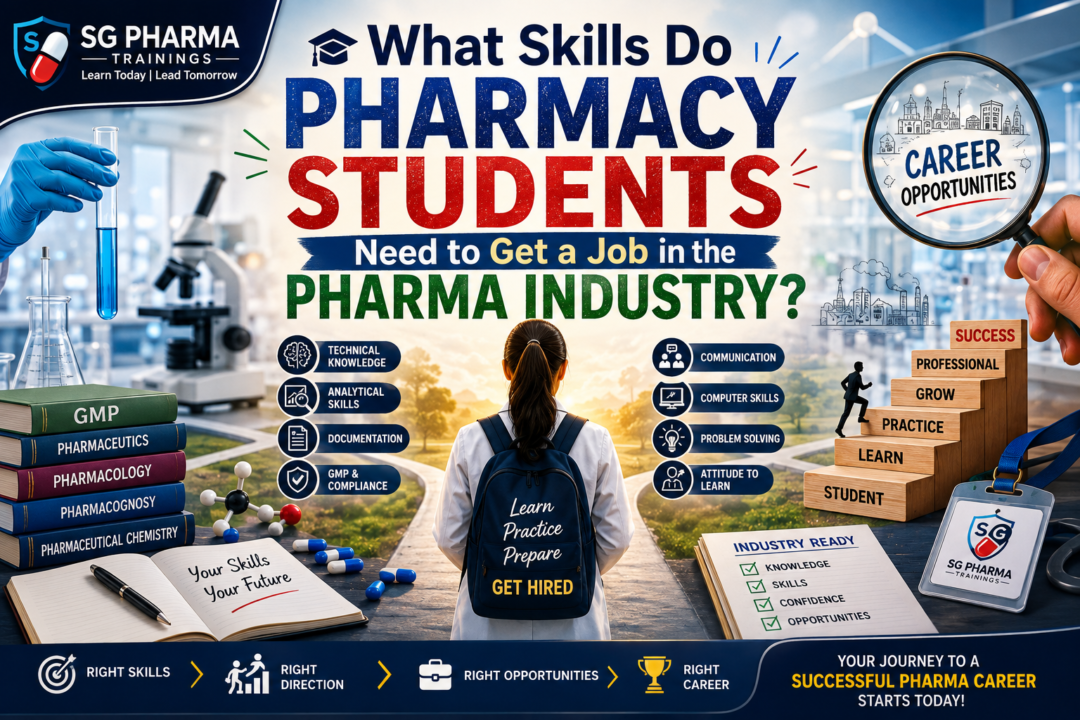
A practical career-readiness guide for B.Pharm, M.Pharm, Pharm.D students and pharmacy freshers
A pharmacy degree provides the academic foundation for a career in the pharmaceutical industry. However, entering the industry requires more than knowing subjects from textbooks.
Whether you are interested in Production, Quality Control, Quality Assurance, Regulatory Affairs, Pharmacovigilance, Clinical Research, Research & Development, or other pharmaceutical functions, employers look for candidates who can apply their knowledge in a practical and professional environment.
The good news is that these skills can be developed while you are still a student.
This guide highlights the technical, documentation, digital, communication and problem-solving skills that can help pharmacy students become more industry-ready.
- 🎯 Why Is a Pharmacy Degree Alone Not Enough?
A pharmacy qualification demonstrates that you have studied pharmaceutical sciences. But during recruitment, companies may also assess whether you can:
- Understand basic pharmaceutical processes
- Follow SOPs and GMP requirements
- Maintain accurate documentation
- Handle laboratory or production-related information
- Communicate professionally
- Use basic computer applications
- Understand and interpret technical information
- Identify problems and think logically
- Work effectively as part of a team
For a fresher, employers generally do not expect extensive industrial experience. Instead, they look for strong fundamentals, willingness to learn, discipline, attention to detail and professional behaviour.
Your degree gets you into the applicant pool. Your skills help you stand out.
- 🔬 Technical Knowledge Every Pharmacy Student Should Have
Students do not need to become experts in every pharmaceutical function. However, having a strong understanding of fundamental concepts can make a significant difference during interviews and early career stages.
🧪 GMP & GLP Basics
Understand the purpose of:
- Good Manufacturing Practices (GMP)
- Good Laboratory Practices (GLP)
- Quality systems
- Hygiene and contamination control
- Documentation and traceability
- Deviation and investigation concepts
A fresher should be able to explain why GMP is important, not simply memorize its definition.
⚙️ QA & QC Fundamentals
Know the basic difference between:
Quality Assurance (QA): Focuses on systems, processes and prevention of quality failures.
Quality Control (QC): Focuses on sampling, testing, analysis and evaluation of materials and products against specifications.
Students should understand concepts such as:
- Specifications
- Sampling
- Testing
- OOS
- OOT
- Deviations
- CAPA
- Change Control
🔬 Basic Analytical Instrument Knowledge
For students interested in QC and analytical roles, understanding the principle, basic instrumentation and applications of common techniques is valuable.
Important examples include:
- HPLC
- Gas Chromatography (GC)
- UV-Visible Spectroscopy
- FTIR
- Dissolution testing
- Karl Fischer titration
- pH measurement
- Analytical balance
You may not have extensive hands-on experience with every instrument. However, you should understand what the instrument does, the basic principle behind it and where it is used.
📋 Pharmaceutical Calculations
Do not underestimate basic calculations.
Students should be comfortable with:
- Concentration calculations
- Dilutions
- Molarity and normality
- Percentage calculations
- Assay calculations
- Unit conversions
- Basic pharmaceutical calculations
📚 Basic Regulatory Knowledge
Develop a basic awareness of important pharmaceutical regulatory concepts and organizations such as:
- CDSCO
- US FDA
- EMA
- ICH
- WHO
You do not need to memorize every regulation. Focus on understanding why regulations and guidelines are important to pharmaceutical quality and patient safety.
- 📝 Documentation Skills – A Must-Have Industry Skill
One of the biggest differences between academic learning and pharmaceutical industry work is the importance of documentation.
In the pharmaceutical industry:
If an activity is not properly documented, it may be difficult to demonstrate that the activity was performed correctly.
Students should become familiar with:
📄 SOPs – Standard Operating Procedures
Understand:
- What an SOP is
- Why SOPs are used
- How procedures are followed
- Importance of following the current approved version
📘 BMR/BPR
Understand the purpose of:
- BMR – Batch Manufacturing Record
- BPR – Batch Packaging Record
These documents provide controlled records of manufacturing and packaging activities.
📓 Logbooks
Understand why equipment and operational activities may require controlled logbook entries.
✍️ Good Documentation Practices
Students should understand the importance of:
- Legible entries
- Correct dates and times
- Proper signatures/initials
- Recording information at the time of activity
- Appropriate corrections
- Maintaining original records
🔐 ALCOA+
Become familiar with the principles of ALCOA+ data integrity:
Attributable • Legible • Contemporaneous • Original • Accurate
The additional expectations commonly summarized under ALCOA+ include principles such as complete, consistent, enduring and available records.
- 💻 Computer & Digital Skills
Modern pharmaceutical workplaces depend heavily on electronic systems and digital documentation.
Pharmacy students should develop practical computer skills, particularly:
Microsoft Word
Useful for:
- Professional documents
- Reports
- SOP-related work
- Technical writing
Microsoft Excel
Useful for:
- Data entry
- Basic formulas
- Sorting and filtering
- Tables
- Basic charts
- Data organization
Microsoft PowerPoint
Useful for:
- Technical presentations
- Training sessions
- Project presentations
- Research presentations
📊 Data Handling
Students should understand the importance of:
- Accurate data entry
- Data organization
- Checking calculations
- Maintaining data integrity
- Avoiding unauthorized alteration of records
Basic awareness of electronic documentation and computerized systems is also increasingly valuable.
- 🗣️ Communication Skills Matter
Technical knowledge alone does not guarantee career success.
A pharmaceutical professional must communicate with colleagues, supervisors, auditors, vendors, healthcare professionals or other stakeholders depending on the role.
| ✉️ Professional Email Writing
Know how to write emails with:
|
🎤 Interview Communication
During interviews:
|
| 📞 Telephone Etiquette
Professional telephone communication is important when interacting with:
|
🧪 Technical Communication
Learn to explain technical concepts clearly. For example, instead of simply saying: “I know HPLC.” Be prepared to explain: Principle → Major components → Working → Applications → Basic troubleshooting That demonstrates understanding rather than memorization.
|
- 🧠 Analytical & Problem-Solving Skills
Pharmaceutical work often involves situations where something does not go as expected.
A student should develop the ability to ask:
What happened? → Why did it happen? → What evidence supports the cause? → What should be done next?
Important skills include:
🔍 Understanding Results
Do not simply record a result. Understand whether it:
- Meets specification
- Shows an unusual trend
- Requires further investigation
⚠️ Identifying Errors
Learn to recognize possible sources of error such as:
- Instrument-related issues
- Sample preparation errors
- Calculation mistakes
- Environmental conditions
- Procedural errors
🔧 Basic Troubleshooting
Develop a systematic approach instead of immediately assuming that the instrument or method is responsible.
🌱 Root-Cause Thinking
Learn the difference between identifying a symptom and identifying a root cause.
This mindset becomes particularly important in QA, QC, Production and other technical functions.
- 🏭 Department-Specific Skills
You do not need to master every department. Start by understanding the area you want to enter.
🏭 Production
Students interested in Production should understand:
- Manufacturing processes
- Dosage forms
- GMP
- Manufacturing equipment
- Batch manufacturing records
- Line clearance
- In-process controls
- Safety and hygiene
🔬 Quality Control (QC)
Important areas include:
- Analytical chemistry fundamentals
- Sampling
- Specifications
- HPLC, GC, UV, FTIR and other analytical techniques
- Assay and related substances
- Dissolution
- Instrument handling
- OOS/OOT basics
- Laboratory documentation
✅ Quality Assurance (QA)
Focus on:
- GMP
- Documentation
- SOPs
- Deviations
- CAPA
- Change Control
- Batch documentation review
- Audits and inspections
- Data integrity
📑 Regulatory Affairs
Develop awareness of:
- Regulatory submissions
- Drug regulations
- CTD/eCTD concepts
- Product registration
- Regulatory documentation
- Major regulatory agencies
🛡️ Pharmacovigilance
Understand:
- Adverse events
- Adverse drug reactions
- Individual Case Safety Reports (ICSRs)
- Case processing
- Safety information
- Medical terminology
- Basic pharmacology
🧑⚕️ Clinical Research
Useful areas include:
- Clinical trial fundamentals
- Clinical trial phases
- GCP
- Study documentation
- Clinical research terminology
- Ethics and patient safety
🧬 Research & Development
Students interested in R&D should strengthen:
- Pharmaceutical formulation concepts
- Analytical techniques
- Research methodology
- Literature review
- Experimental design
- Scientific documentation
- Data interpretation
- 📄 What Should a Pharmacy Fresher Put on a Resume?
A fresher’s resume does not need to be filled with unnecessary information.
Focus on relevant and verifiable skills.
Include:
🎓 Education
Degree, institution and relevant academic achievements.
🏭 Internship/Industrial Training
Mention the department, activities and what you learned.
🔬 Projects
Include academic or research projects that demonstrate technical knowledge.
⚙️ Instruments & Techniques
Mention techniques you have actually studied or used.
📜 Certifications
Include relevant certifications in areas such as GMP, clinical research, pharmacovigilance, analytical techniques or other professional skills.
💻 Software Skills
Mention relevant computer applications.
🏆 Achievements
Include meaningful academic, research or professional achievements.
Avoid:
❌ False skills
❌ Unnecessary personal information
❌ Very long paragraphs
❌ Unprofessional email addresses
❌ Spelling and grammatical errors
❌ Listing every subject studied in college
A good fresher resume should answer one question quickly: “Why should this candidate be considered for this role?”
- ⚠️ Common Mistakes Pharmacy Freshers Make
- Applying for every job without understanding the role
- Knowing definitions but not concepts
- Putting skills on the resume that you cannot explain
- Ignoring communication skills
- Having an unprofessional resume
- Not preparing for interviews
- Expecting the first job to be perfect
Your first role is often an opportunity to gain industry exposure, practical knowledge and professional experience.
- 📅 30-Day Pharma Industry Readiness Plan
You do not need to wait until graduation to start preparing.
🗓️ Week 1 – GMP & Documentation
Focus on:
- GMP basics
- GLP basics
- SOPs
- GDP
- ALCOA+
- BMR/BPR
- Deviations
- CAPA
Goal: Understand how pharmaceutical companies maintain controlled processes and records.
🗓️ Week 2 – Technical Skills
Choose the area related to your career goal.
For QC, revise:
- HPLC
- GC
- UV
- FTIR
- Dissolution
- Karl Fischer
- Basic calculations
For Production/QA, focus on:
- Manufacturing processes
- GMP
- Documentation
- Line clearance
- In-process controls
- Deviations and CAPA
Goal: Strengthen practical technical fundamentals.
🗓️ Week 3 – Resume, LinkedIn & Communication
Work on:
- Professional resume
- LinkedIn profile
- Professional email writing
- Self-introduction
- Technical explanation skills
- Communication practice
Goal: Present yourself professionally.
🗓️ Week 4 – Interview & Job Preparation
Practice:
- HR questions
- Technical questions
- Department-specific questions
- Company research
- Job-description analysis
Start applying for relevant positions, rather than applying randomly to every vacancy.
Goal: Become confident enough to participate in interviews.
- ✅ Final Checklist: “Am I Industry Ready?”
Before applying for your first pharmaceutical job, ask yourself:
☐ Can I explain basic GMP principles?
☐ Do I understand SOPs and Good Documentation Practices?
☐ Do I understand ALCOA+?
☐ Can I explain the basics of my preferred department?
☐ Can I explain the instruments or techniques listed on my resume?
☐ Can I perform basic pharmaceutical calculations?
☐ Can I use Word and Excel confidently?
☐ Can I write a professional email?
☐ Can I introduce myself confidently in an interview?
☐ Can I explain my academic project clearly?
☐ Is my resume accurate and professionally formatted?
☐ Have I researched the company before applying?
☐ Am I willing to learn and adapt?
If you can confidently answer “Yes” to most of these questions, you are already moving toward becoming an industry-ready pharmacy graduate.
🚀 Final Takeaway
A successful pharmaceutical career is not built on a degree alone.
It is built through a combination of:
🎓 Academic Knowledge
- 🔬 Technical Skills
- 📝 Documentation Discipline
- 💻 Digital Skills
- 🗣️ Communication
- 🧠 Problem-Solving
- 🤝 Professional Attitude
- 📚 Continuous Learning
As a pharmacy student or fresher, you do not need to know everything before entering the industry.
What matters is having strong fundamentals, genuine interest, professional discipline and the willingness to keep learning.
Your first job may be the beginning of your pharmaceutical career—but the skills you develop along the way will shape how far that career can go.
💊 Start building your skills before you start applying.
PharmaTimes Official is committed to providing pharmacy students and professionals with useful career guidance, pharmaceutical knowledge, industry updates and job opportunities to help them move closer to their career goals.
Keep learning. Keep improving. Keep moving forward. 🚀