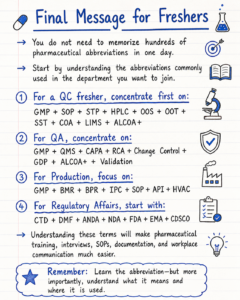

Pharma Industry Abbreviations Every Fresher Should Know
Entering the pharmaceutical industry can feel confusing for freshers because almost every department uses abbreviations.
During training, interviews, laboratory work, documentation, audits, manufacturing activities, and regulatory discussions, you may frequently hear terms such as GMP, SOP, OOS, CAPA, BMR, COA, HPLC, LIMS, QMS, ANDA, SAE, and ALCOA+.
Understanding these abbreviations is important because they are part of the everyday language of the pharmaceutical industry.
1. GMP — Good Manufacturing Practices
GMP stands for Good Manufacturing Practices.
GMP is a system that ensures pharmaceutical products are consistently manufactured and controlled according to established quality standards.
2. cGMP — Current Good Manufacturing Practices
cGMP stands for Current Good Manufacturing Practices.
The word “current” emphasizes that companies should use up-to-date systems, technologies, procedures, and controls appropriate for pharmaceutical manufacturing.
3. SOP — Standard Operating Procedure
SOP stands for Standard Operating Procedure.
An SOP is an approved written instruction explaining how a particular activity should be performed.
4. STP — Standard Testing Procedure
STP stands for Standard Testing Procedure.
An STP describes the analytical procedure used for testing a material or product.
Quality Control Abbreviations
5. QC — Quality Control
QC stands for Quality Control.
QC mainly involves sampling, testing, laboratory investigation, documentation, and evaluation of materials and products against approved specifications.
6. HPLC — High-Performance Liquid Chromatography
HPLC stands for High-Performance Liquid Chromatography.
It is one of the most widely used analytical techniques in pharmaceutical QC.
7. GC — Gas Chromatography
GC stands for Gas Chromatography.
GC is commonly used for analyzing volatile substances.
8. UV — Ultraviolet Spectroscopy
UV generally refers to Ultraviolet or UV-Visible Spectroscopy.
9. FTIR — Fourier Transform Infrared Spectroscopy
FTIR stands for Fourier Transform Infrared Spectroscopy.
FTIR is widely used for the identification of pharmaceutical raw materials and compounds based on their infrared spectrum.
10. KF — Karl Fischer
KF stands for Karl Fischer.
Karl Fischer titration is commonly used to determine water or moisture content in pharmaceutical materials.
11. TOC — Total Organic Carbon
TOC stands for Total Organic Carbon.
TOC analysis is commonly used to monitor organic contamination in pharmaceutical water systems and cleaning applications.
12. LOD — Loss on Drying
LOD stands for Loss on Drying.
LOD determines the amount of volatile matter, usually including moisture, lost from a sample under specified drying conditions.
13. ROI — Residue on Ignition
ROI stands for Residue on Ignition.
It is used to determine the amount of inorganic residue remaining after ignition of a sample under specified conditions.
14. RSD — Relative Standard Deviation
RSD stands for Relative Standard Deviation.
It is commonly used to evaluate the precision or variability of analytical results.
Formula:
RSD (%) = Standard Deviation / Mean × 100
15. SST — System Suitability Test
SST stands for System Suitability Test.
SST verifies that an analytical system is performing adequately before or during sample analysis.
16. OOS — Out of Specification
OOS stands for Out of Specification.
An OOS result is a test result that falls outside the approved specification or acceptance criteria.
17. OOT — Out of Trend
OOT stands for Out of Trend.
An OOT result may still meet the specification but shows an unusual change compared with historical or expected results.
Quality Assurance Abbreviations
18. QA — Quality Assurance
QA stands for Quality Assurance.
QA ensures pharmaceutical quality systems are properly established, implemented, monitored, and maintained.
19. QMS — Quality Management System
QMS stands for Quality Management System.
A QMS is the overall system used to manage pharmaceutical quality.
20. CAPA — Corrective and Preventive Action
CAPA stands for Corrective and Preventive Action.
21. RCA — Root Cause Analysis
RCA stands for Root Cause Analysis.
RCA is used to determine the underlying cause of a deviation, failure, complaint, OOS, or other quality problem.
22. CC — Change Control
CC commonly stands for Change Control.
Change control is a formal system for evaluating, approving, implementing, and documenting changes that may affect product quality or validated systems.
Manufacturing Abbreviations
23. BMR — Batch Manufacturing Record
BMR stands for Batch Manufacturing Record.
It contains documented information about the manufacturing activities performed for a specific batch.
24. BPR — Batch Packaging Record
BPR stands for Batch Packaging Record.
It contains information related to packaging operations for a specific batch.
25. API — Active Pharmaceutical Ingredient
API stands for Active Pharmaceutical Ingredient.
The API is the substance responsible for the intended pharmacological activity of a medicine.
26. FPP — Finished Pharmaceutical Product
FPP stands for Finished Pharmaceutical Product.
It refers to the completed pharmaceutical product in its final dosage form after manufacturing and packaging, as applicable.
27. IPC — In-Process Control
IPC stands for In-Process Control.
IPC testing is performed during manufacturing to ensure the process remains within established limits.
Documentation & Data Integrity
28. GDP — Good Documentation Practices
In pharmaceutical quality systems, GDP commonly means Good Documentation Practices.
GDP ensures records are clear, accurate, complete, traceable, and properly maintained.
29. ALCOA
ALCOA is a key concept in pharmaceutical Data Integrity.
It stands for:
A — Attributable
L — Legible
C — Contemporaneous
O — Original
A — Accurate
30. ALCOA+
ALCOA+ extends the original ALCOA principles.
The “+” commonly includes:
- Complete
- Consistent
- Enduring
- Available
31. DI — Data Integrity
DI stands for Data Integrity.
Data integrity means that data are complete, consistent, accurate, trustworthy, and maintained appropriately throughout the data lifecycle.
32. LIMS — Laboratory Information Management System
LIMS stands for Laboratory Information Management System.
33. CDS — Chromatography Data System
CDS stands for Chromatography Data System.
A CDS is software used to acquire, process, review, store, and manage chromatographic data generated from instruments such as HPLC and GC.
Validation & Qualification
34. IQ — Installation Qualification
IQ stands for Installation Qualification.
It confirms that equipment has been installed correctly according to approved requirements.
35. OQ — Operational Qualification
OQ stands for Operational Qualification.
It demonstrates that equipment operates as intended throughout specified operating ranges.
36. PQ — Performance Qualification
PQ stands for Performance Qualification.
It provides documented evidence that equipment or a system performs effectively and reproducibly under routine operating conditions.
37. CSV — Computer System Validation
CSV stands for Computer System Validation.
CSV provides documented evidence that a computerized system consistently performs according to its intended use and specified requirements.
Regulatory Affairs Abbreviations
38. US FDA — United States Food and Drug Administration
The FDA is the US regulatory authority responsible for regulating pharmaceuticals and several other product categories.
39. EMA — European Medicines Agency
EMA stands for European Medicines Agency.
It plays a major role in the scientific evaluation and supervision of medicines in the European Union.
40. CDSCO — Central Drugs Standard Control Organisation
CDSCO is India’s central regulatory authority for drugs and medical devices under the applicable regulatory framework.
This abbreviation is particularly important for Indian pharmacy students and freshers.
41. ANDA — Abbreviated New Drug Application
ANDA stands for Abbreviated New Drug Application.
It is associated with applications for approval of generic drug products in the United States.
42. NDA — New Drug Application
NDA stands for New Drug Application.
It is submitted to the US FDA when seeking approval to market a new drug under the applicable regulatory pathway.
43. DMF — Drug Master File
DMF stands for Drug Master File.
A DMF contains confidential detailed information about facilities, processes, or materials involved in manufacturing, processing, packaging, or storing pharmaceutical substances/products, depending on the type of DMF.
44. CTD — Common Technical Document
CTD stands for Common Technical Document.
It provides a harmonized structure for regulatory submissions.
Major CTD modules include:
Module 1 — Regional Administrative Information
Module 2 — Summaries
Module 3 — Quality
Module 4 — Nonclinical Reports
Module 5 — Clinical Reports
Clinical Research & Pharmacovigilance
45. GCP — Good Clinical Practice
GCP stands for Good Clinical Practice.
GCP is an ethical and scientific quality standard for designing, conducting, recording, and reporting clinical trials involving human participants.
46. ICF — Informed Consent Form
ICF stands for Informed Consent Form.
It documents informed consent provided by a clinical-trial participant according to applicable requirements.
47. CRF — Case Report Form
CRF stands for Case Report Form.
It is used to capture protocol-required information for clinical-trial participants.
48. AE — Adverse Event
AE stands for Adverse Event.
An AE is an unfavorable medical occurrence in a patient or clinical-trial participant receiving a medicinal product, regardless of whether it is necessarily related to the product.
49. ADR — Adverse Drug Reaction
ADR stands for Adverse Drug Reaction.
It refers to a harmful and unintended response associated with the use of a medicinal product under the applicable definition and context.
50. SAE — Serious Adverse Event
SAE stands for Serious Adverse Event.
Seriousness is determined according to defined regulatory criteria, such as events involving death, life-threatening situations, hospitalization, significant disability, or other medically important conditions.
Other Important Abbreviations
51. COA — Certificate of Analysis
COA stands for Certificate of Analysis.
A COA summarizes analytical test results for a material or product against specified requirements.
52. MSDS / SDS — Material Safety Data Sheet / Safety Data Sheet
SDS stands for Safety Data Sheet.
Older terminology may use MSDS — Material Safety Data Sheet.
53. PPE — Personal Protective Equipment
PPE stands for Personal Protective Equipment.
54. HVAC — Heating, Ventilation and Air Conditioning
HVAC systems help control environmental conditions such as:
- Temperature
- Humidity
- Air movement
- Pressure differentials
- Air cleanliness
They are especially important in pharmaceutical manufacturing and controlled areas.